What a Website’s DNS Records Reveal About Who Built It
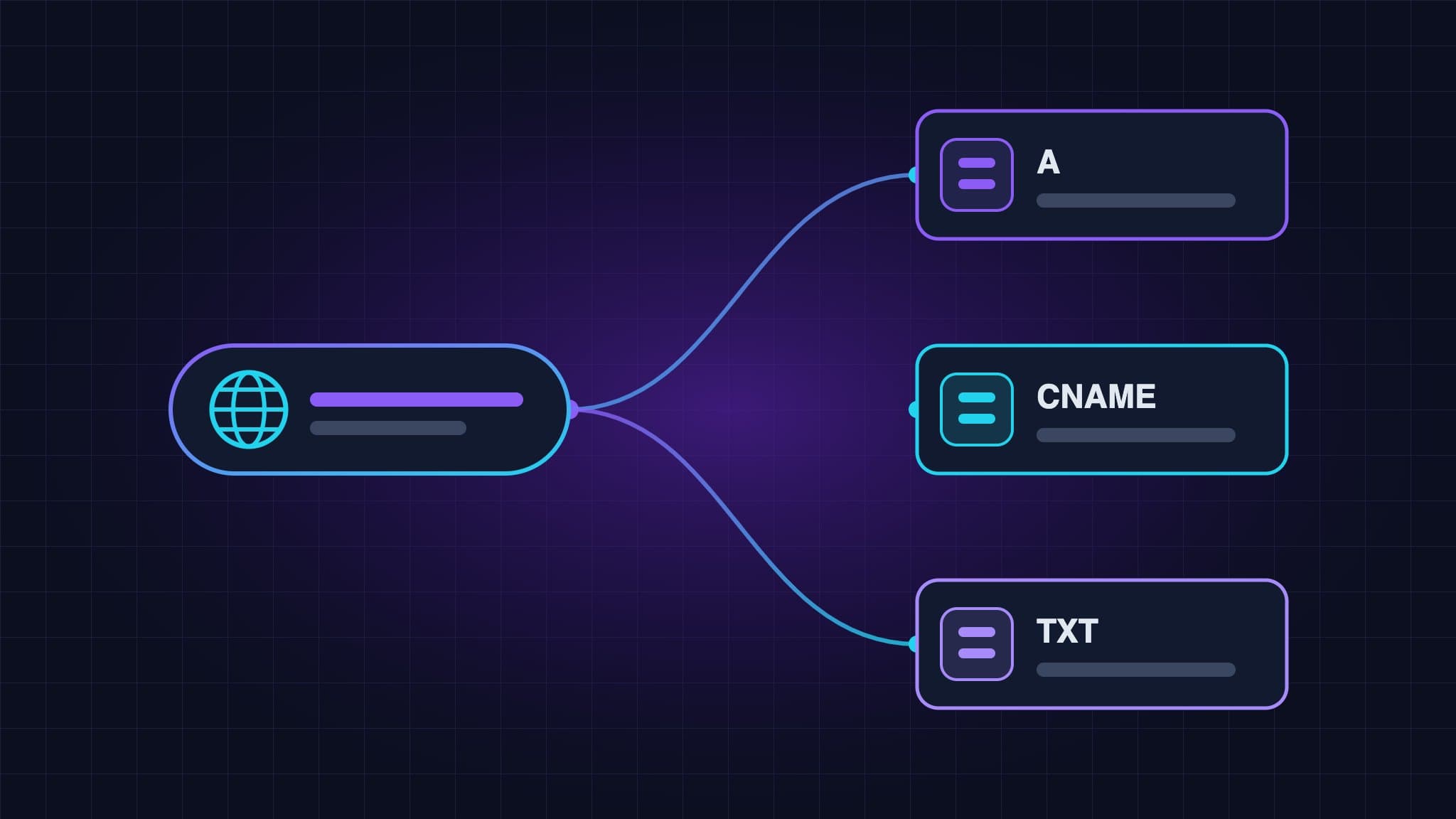
A website can hide almost everything in its page: the badge, the generator tag, the credit line. What it can't hide is where it lives. To put a site on a custom domain, the owner has to point that domain at a host, and the host decides what those records look like. Anyone can look them up. Sometimes the answer names an AI builder outright. More often it names a general-purpose host, and then it proves nothing about AI at all. This post explains how to tell the two apart.
Three record types worth knowing
- A points a name at an IP address. For a root domain (
example.com), it's usually the only option, so builders give customers a fixed address to use. - CNAME points a name at another name, such as
www.example.com→something.host.com. Because the target is a readable name, CNAMEs are the most informative records of all. - TXT holds free text. Services use it to confirm you own a domain, and many ask you to leave the record in place permanently.
How to look them up
Any free online DNS lookup tool works. If you have a terminal, dig is faster (on Windows, nslookup -type=A example.com does the same job):
dig +short A example.com
dig +short CNAME www.example.com
dig +short TXT example.com
Check both the root domain and the www version. Owners often set them up differently, and the www CNAME is frequently the more revealing of the two.
The records we've verified
We only list values we confirmed in the platform's own documentation or by looking up real sites in November 2026. Hosts change their addresses from time to time, so treat this as a snapshot, not a permanent list.
Lovable (custom domain) · A
185.158.133.1
Specific to Lovable
Every Lovable custom domain we looked up that wasn’t behind a proxy
Lovable (its own subdomains) · A
185.41.148.x
Specific to Lovable
Address block registered to Lovable
Base44 · CNAME
base44.onrender.com
Specific to Base44
Base44 docs, and Base44 apps we looked up
Bolt.new · CNAME / ALIAS
site-dns.bolt.host
Specific to Bolt.new
Bolt’s domain setup guide
Replit · TXT
replit-verify=…
Specific to Replit
Replit docs: the record must stay for certificate renewal
Shopify · A / CNAME
23.227.38.65 / shops.myshopify.com
A store platform, not AI
Shopify help center
Vercel · A
76.76.21.21
General-purpose host
Vercel docs
Netlify · A / ALIAS
75.2.60.5 / apex-loadbalancer.netlify.com
General-purpose host
Netlify docs
Render · A
216.24.57.1
General-purpose host
Base44’s docs list it for root domains, but it’s Render’s shared address
| Platform | Record | Value | What it tells you |
|---|---|---|---|
| Lovable (custom domain) | A | 185.158.133.1 | Specific to LovableEvery Lovable custom domain we looked up that wasn’t behind a proxy |
| Lovable (its own subdomains) | A | 185.41.148.x | Specific to LovableAddress block registered to Lovable |
| Base44 | CNAME | base44.onrender.com | Specific to Base44Base44 docs, and Base44 apps we looked up |
| Bolt.new | CNAME / ALIAS | site-dns.bolt.host | Specific to Bolt.newBolt’s domain setup guide |
| Replit | TXT | replit-verify=… | Specific to ReplitReplit docs: the record must stay for certificate renewal |
| Shopify | A / CNAME | 23.227.38.65 / shops.myshopify.com | A store platform, not AIShopify help center |
| Vercel | A | 76.76.21.21 | General-purpose hostVercel docs |
| Netlify | A / ALIAS | 75.2.60.5 / apex-loadbalancer.netlify.com | General-purpose hostNetlify docs |
| Render | A | 216.24.57.1 | General-purpose hostBase44’s docs list it for root domains, but it’s Render’s shared address |
The trap: shared addresses
Some builders document two ways to connect a domain: a CNAME to a name of their own, and an A record for root domains that points at the company actually running their servers. Base44's root-domain address belongs to Render, and one of Bolt's documented addresses belongs to Netlify. Both serve thousands of sites that have nothing to do with AI. Finding one of those addresses tells you the host, not the builder. That's why our detector matches only values a single builder uses, and ignores the rest.
The same applies to Vercel and Netlify themselves. Many AI-built apps are deployed there, and so are many hand-built ones. We give those hosts a small weight in the score, never a verdict.
When DNS shows nothing useful
If the A records come back as Cloudflare addresses (they usually start with 104. or 172.6), the site sits behind Cloudflare's proxy, which hides the real host. Two of the seven Lovable custom domains we checked were set up this way, even though Lovable recommends turning the proxy off. In those cases, the page itself and its JavaScript are the place to look. The same goes for an app exported from a builder and deployed somewhere else: DNS will show the new host, not the tool that generated the code.
TXT records: a list of the site's tools
Even when TXT records say nothing about the builder, they often list the services a business uses, because each one asks for its own verification record. Common examples:
google-site-verification=…: the site is registered in Google Search Console.facebook-domain-verification=…: the domain is verified for Meta business tools.v=spf1 include:_spf.google.com: email runs on Google Workspace (include:spf.protection.outlook.commeans Microsoft 365).
None of these say anything about AI. They're still useful context: a domain with no mail records and no verifications at all is often a quick side project, while a long list usually means a business that has been running for a while.
What DNS can and can't prove
DNS tells you where a site is hosted today. When the host is an AI builder's own platform, that's strong evidence the site was made there, and it stays visible even after the badge is removed. When the host is a general-purpose cloud, it's neutral. And it can never tell you how much of the site a person wrote or edited afterwards.
Since November 2026, every scan on our AI website detector looks up a site's A, CNAME and TXT records alongside its page and JavaScript files, and shows the exact record when one matches. The methodology covers how it's weighted, and the 10-check guide shows where DNS fits among the other checks.